Skip to content
Every field trip planner reaches the same fork: book a school bus or book a charter bus. The charter bus vs school bus choice comes down to four things: how long the ride is, who is riding, what they are carrying and how many stops the day includes. A third-grade class heading twenty minutes across Corpus Christi for a museum visit has different needs from a high school band driving to a regional contest with instruments, uniforms and a late return. This post sets the two vehicles side by side and walks through safety, drivers, comfort and cost. It closes with a simple way to pick, so you can send a quote request knowing exactly what to ask for.
What Is a School Bus?
A school bus is built for the daily routine of moving students between home and campus, along with short local trips. You can spot one by its yellow body, its flashing lights and the stop arm that swings out while children board or leave. Inside, the seats are bench-style, set close together, with tall padded backs. That layout is called compartmentalization, and it is how large school buses protect riders.
Seating capacity on a school bus is counted by seat. Federal regulation does not set how many people sit on each one. Manufacturers rate capacity on three small elementary students per typical 39-inch seat, and providers generally fit three smaller elementary students or two adult-size high school students per seat. A bus rated for 72 elementary riders therefore seats about 48 high school students, which is worth knowing before a multi-grade trip.
School buses also cover more than the morning route. A school-related event is any school-sponsored activity on or off school grounds, including field trips, sports events, band concerts and competitions. Federal law regulates the sale of new vehicles, and each state decides how students must be transported.
A standard school bus usually goes without a restroom, an under-floor luggage bay or reclining seats. On a half-hour ride to a science museum, nobody misses them. On a four-hour ride to San Antonio, each one counts.
What Is a Charter Bus?
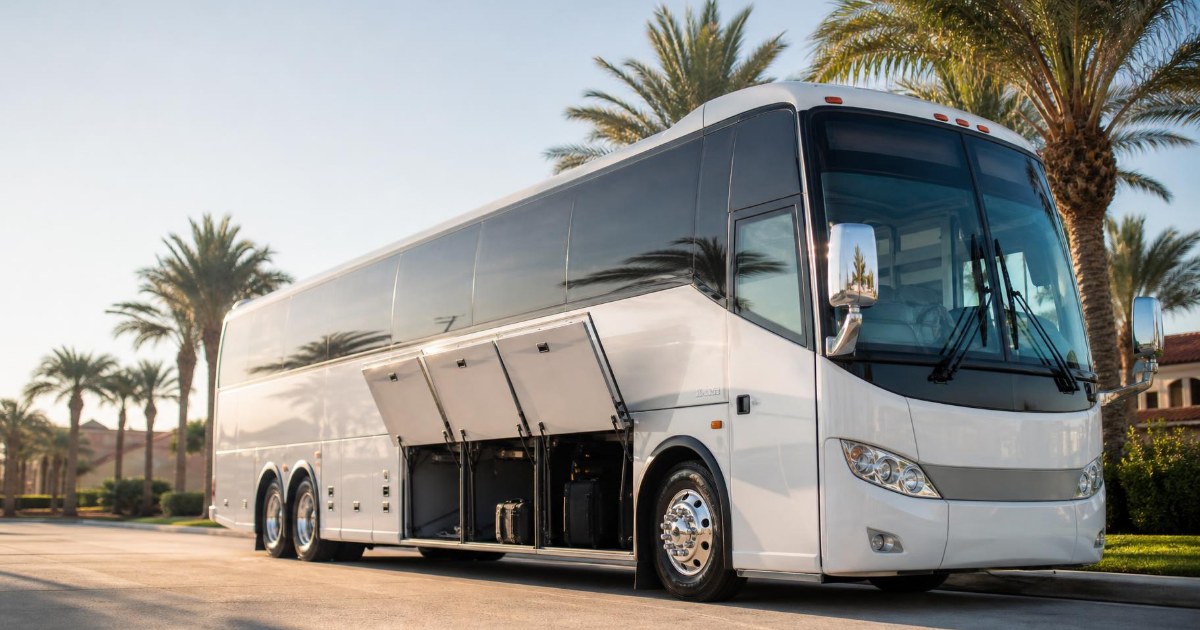
A charter bus is a vehicle a group hires privately for its own itinerary. The group chooses the pickup, the stops and the return time, and the bus and driver stay with the group all day. That flexibility covers a drop-off at a museum, a lunch stop and a late return after a game. Most charter buses are motorcoaches built for highway travel, with reclining seats, climate control and luggage storage. Full-size coaches add a restroom, and many carry Wi-Fi, power outlets and a PA system.
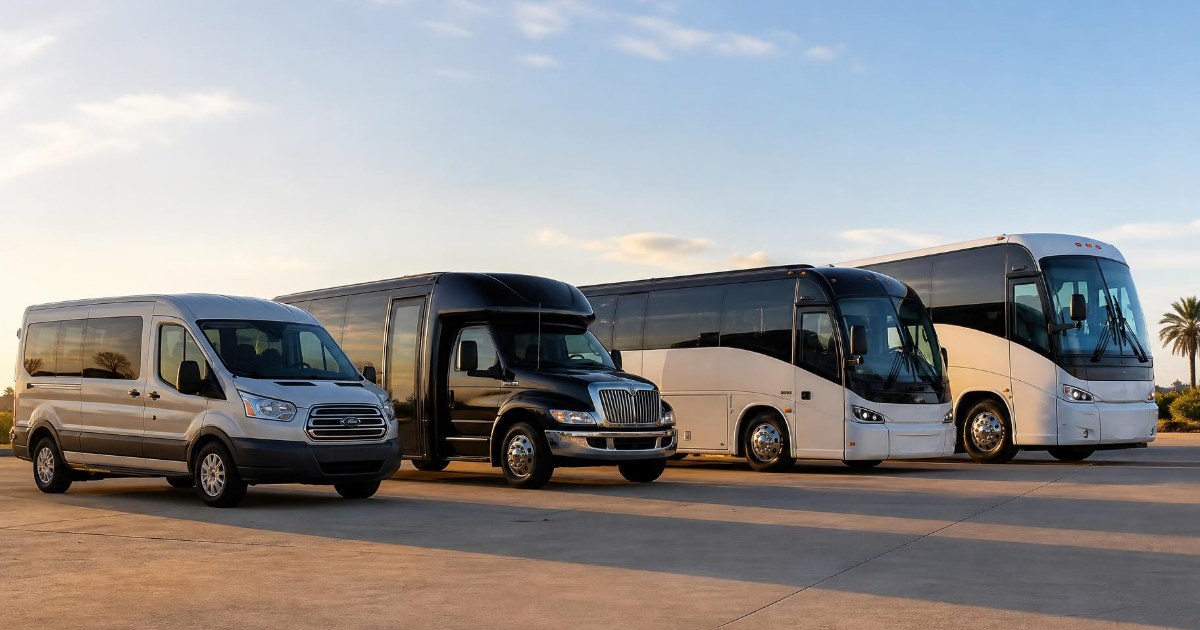
Distance Brothers lists four vehicles on its site, so a group can match the size to the headcount. The fleet includes a 14 passenger van for small student groups or faculty travel, a 34 passenger charter bus for mid-size classes, clubs and day trips and a 56 passenger bus for large groups and long distances, with restrooms, power outlets and luggage storage. It also includes a full-size 44 passenger school bus built for long journeys, with comfortable seating, overhead storage and luggage space.
On its School Trips page, Distance Brothers names the amenities its coaches carry for student groups: climate control, reclining seats, onboard Wi-Fi, entertainment systems and PA systems that help teachers speak to the whole group. The 34 passenger mini-coach adds overhead bins that keep bags organized, and restrooms come on the larger coaches.
School Bus vs. Charter Bus at a Glance
Here is the school bus vs charter bus comparison in one view. The charter column describes a full-size motorcoach, and details vary by vehicle.
| School bus | Charter bus | |
|---|---|---|
| Purpose | Daily student routes and short local trips | Private hire for a group's own itinerary, local or long distance |
| Seating | Bench seats counted by seat: three small elementary students or two high school students each | Paired reclining seats counted by passenger |
| Comfort | Close-set padded benches built for short rides | Reclining seats, climate control and more legroom |
| Amenities | Usually basic | Wi-Fi, power outlets, PA system and entertainment, with a restroom on full-size coaches |
| Luggage | Limited, with no under-floor bay on a standard bus | Under-floor luggage bays, plus overhead bins on the mini-coach |
| Restraint system | Compartmentalization on large buses, belts on small buses, three-point belts under Texas law for district trips | Lap and shoulder belts on new motorcoaches built since November 2016 |
| Driver licensing | Commercial license with passenger and school bus endorsements for school-sponsored student trips | Commercial license with passenger endorsement |
| Cost basis | Usually a lower hourly rate | Hourly or mileage rate by vehicle, with a minimum charge |
| Best use | Short local trips with younger students | Long routes, multiple stops, overnight trips, gear and mixed-age groups |
Safety: How Each Bus Protects Passengers
Both vehicles protect riders, and each does it in the way that fits where it drives. School buses are designed for neighborhood streets and school zones. Large school buses use strong, closely spaced seats with energy-absorbing seat backs that protect children without buckling up. Small school buses, at a gross vehicle weight rating of 10,000 pounds or less, must have lap or lap and shoulder belts at every seat. Flashing lights and a stop arm halt traffic while students board.
Motorcoaches are designed for highway speeds. A federal rule requires lap and shoulder belts at every seat on new motorcoaches built from November 2016 on, and belts could reduce fatalities by up to 44% and moderate-to-severe injuries by up to 45%.
Students face the most risk around the bus. Less than 1% of all traffic fatalities involve children on school transportation vehicles, and children are more at risk while approaching or leaving a bus than while riding. A chaperone at each door during loading and unloading, plus a pickup spot away from moving traffic, protects that moment.
Texas law adds a seat belt requirement for student trips. Senate Bill 693 requires any bus a school district operates or contracts for, including a school-chartered bus, to have a three-point seat belt for each passenger and the operator. It carried exceptions for model year 2017 or earlier buses and for a board vote that the budget does not permit compliance. Senate Bill 546 removed the older-bus exception, and boards had to act by May 29, 2026. Your district's transportation office can tell you how its board acted.
Before booking any bus, look up the company. Anyone can check a bus company's safety record by company name or USDOT number, and because many bus companies have similar names, it helps to ask for the number. Distance Brothers lists USDOT #2252588 and MC-852086 on its About page, alongside its federal operating authority and safety standards.
Who Drives: Licensing and Hours on the Road
Both vehicles need a professional behind the wheel. A commercial driver's license with the right endorsement is required for any vehicle designed to carry 16 or more passengers, including the driver, and for-hire interstate passenger carriers must hold federal operating authority and at least $5 million in insurance on vehicles of that size.
The endorsements differ by trip. A driver carrying students in a school bus to or from school, or to school-sponsored events, needs both the P passenger endorsement and the S school bus endorsement. A driver carrying students or adults to events the school does not sponsor needs only the P endorsement. For a planner, the license follows the vehicle: motorcoach drivers hold the passenger endorsement, and school bus drivers carrying students add the school bus endorsement.
Time on the road has its own limits. A passenger-carrying driver may not drive more than 10 hours after 8 consecutive hours off duty, or at all after 15 hours on duty. A long day trip, such as Corpus Christi to Dallas and back with several hours at the venue, can reach those limits. An overnight trip changes the plan too. At that point a relief driver or driver lodging enters the quote, and on long straight-through trips a motorcoach company may send a relief driver ahead. Share your departure and return times at the first request so the driver plan fits your day.
Distance Brothers sends a licensed, professional driver with every rental, and its drivers are background-checked and experienced in student group transportation.
Comfort, Amenities and Room for Gear
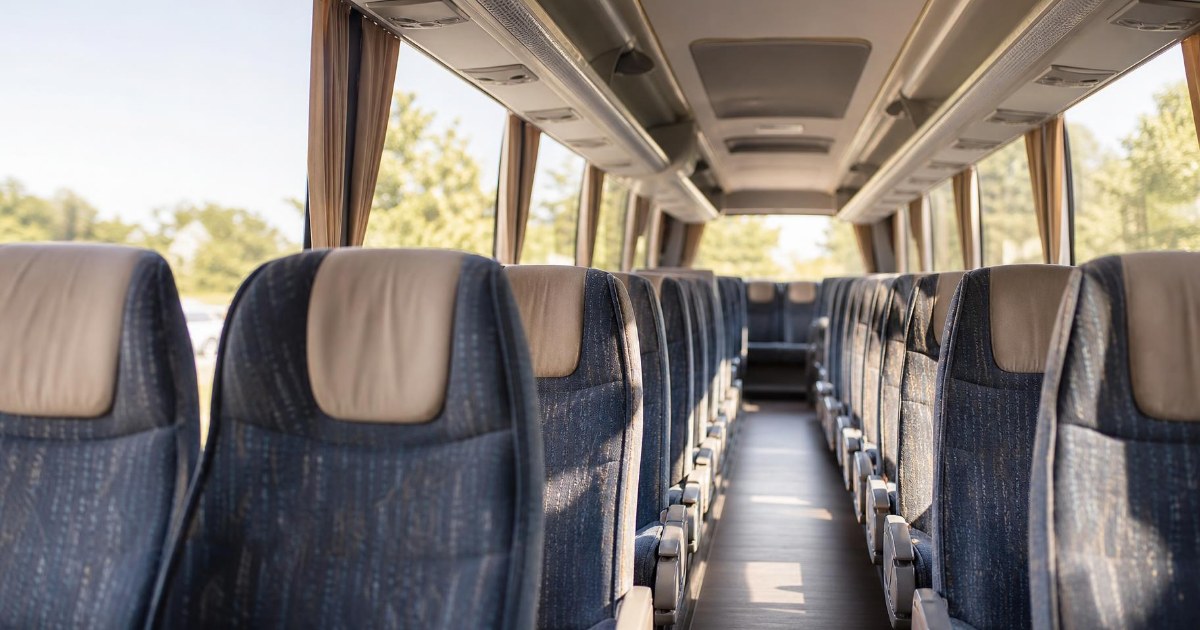
Comfort matters most once the ride passes two hours. Elementary-sized bench seats suit younger children, and by high school the same seats feel cramped. Reclining seats with more legroom give older students and adult chaperones room to settle in. Climate control keeps the cabin steady through a Coastal Bend afternoon and a cold early departure alike.
An onboard restroom changes a long day. Distance Brothers places restrooms on its larger coaches, which means fewer roadside stops and a schedule that holds. Wi-Fi and power outlets let students charge devices or stream educational videos, and a PA system lets a teacher brief the whole bus without shouting over the seat backs.
Gear is the other half of comfort. A school bus has little room for bags beyond the seats and the aisle, so a band's instrument cases or a team's equipment bags compete with passengers for space. A full-size coach has storage bays under the floor. That is why a Distance Brothers reservation specialist recommended two full-size charter buses for a 95-person football playoff group, since those buses have storage bays below for equipment and luggage. Overnight trips lean on the same bays for suitcases, and the 34 passenger mini-coach adds overhead bins for smaller items.
Cost: What You Pay for Each Option
A school bus usually carries a lower hourly rate, and on a short local trip that gap decides the budget. A charter quote responds to more inputs: vehicle size, hours, miles, a minimum booking length, season, tolls, parking and overnight driver lodging.
Distance Brothers posts estimates by vehicle on its Prices page. The 14 passenger van runs $90 to $110 per hour or $3.00 to $3.75 per mile, with a $500 minimum charge. The 34 passenger mini coach runs $110 to $135 per hour or $3.50 to $4.25 per mile, with a $625 minimum. The 56 passenger bus runs $135 to $185 per hour or $3.75 to $4.75 per mile, with a $750 minimum. Every trip has a 5-hour minimum, and mileage overages can add a charge.
Season and overnight needs move the final number. Demand and price often rise from April to June, and an overnight trip adds driver lodging, plus any parking permits or tolls.
Cost per passenger gives the fairest comparison. In one example Distance Brothers shares, a high school football coach moved 95 players, coaches and trainers from Corpus Christi to the Alamodome in San Antonio on two full-size charter buses for $3,150, about $33 per person. Divide any quote by the number of riders before comparing options.
Which Bus Fits Your Trip?
Two short lists turn the comparison into a decision.
Choose a school bus when…
- The trip is short and local, such as a museum or library visit across town, and the ride is well under two hours.
- Younger students are riding and chaperones want to keep every child in view from any seat.
- The group has no luggage, instruments or equipment to carry.
- The budget is tight and the day has a single destination.
Choose a charter bus when…
- The route is long or leaves town, and the ride runs past two hours each way.
- The day has several stops, such as a campus tour, a lunch and a game, and the bus stays with the group between them.
- The trip is overnight or runs several days, so suitcases and a rested driver come into the plan.
- Older students, mixed-age groups or adults are riding and need seats with legroom.
- Instruments, uniforms or sports gear are coming along and need a luggage bay.
- A passenger uses a wheelchair or needs an accessible vehicle. Distance Brothers offers ADA-accessible buses with wheelchair lifts, wide aisles and secure seating areas.
Large multi-grade trips can use both vehicle types. Younger grades can ride a school bus for the short hop while the older students and the band take a coach with room for gear. Ask the company to quote each vehicle so you can compare them side by side.
Booking a Bus for a School Field Trip
A school bus rental for a field trip goes smoothly when the quote request is complete. Gather the full headcount including chaperones, the complete itinerary with every stop, departure and return times, the gear that is coming and any wheelchair or mobility needs. Raise mobility needs at the first request. An over-the-road bus operator providing charter service must provide an accessible bus to a passenger with a disability who requests one and may require up to 48 hours' advance notice, so early word keeps the right vehicle on your trip.
Then ask the bus company four questions. Which vehicle will be assigned to your trip? What qualifications do its drivers hold? What are its USDOT number and safety record? Does the bus meet your district's seat belt and transportation policies? A clear answer to each one tells you the company is ready for student travel.
Book early for spring. Demand and price often rise from April to June, and the sooner the vehicle and driver are confirmed, the more options your school has.
Three questions decide the choice: how long the ride is, who is riding with what, and how many stops the day has. Short local trips with younger students and no gear suit a school bus, and long days, overnight trips, older students and gear suit a charter bus. School groups can review vehicles, amenities and accessibility options on the School Trips page, and the Contact page takes your passenger count, dates and itinerary so Distance Brothers can quote the right vehicle for your trip.