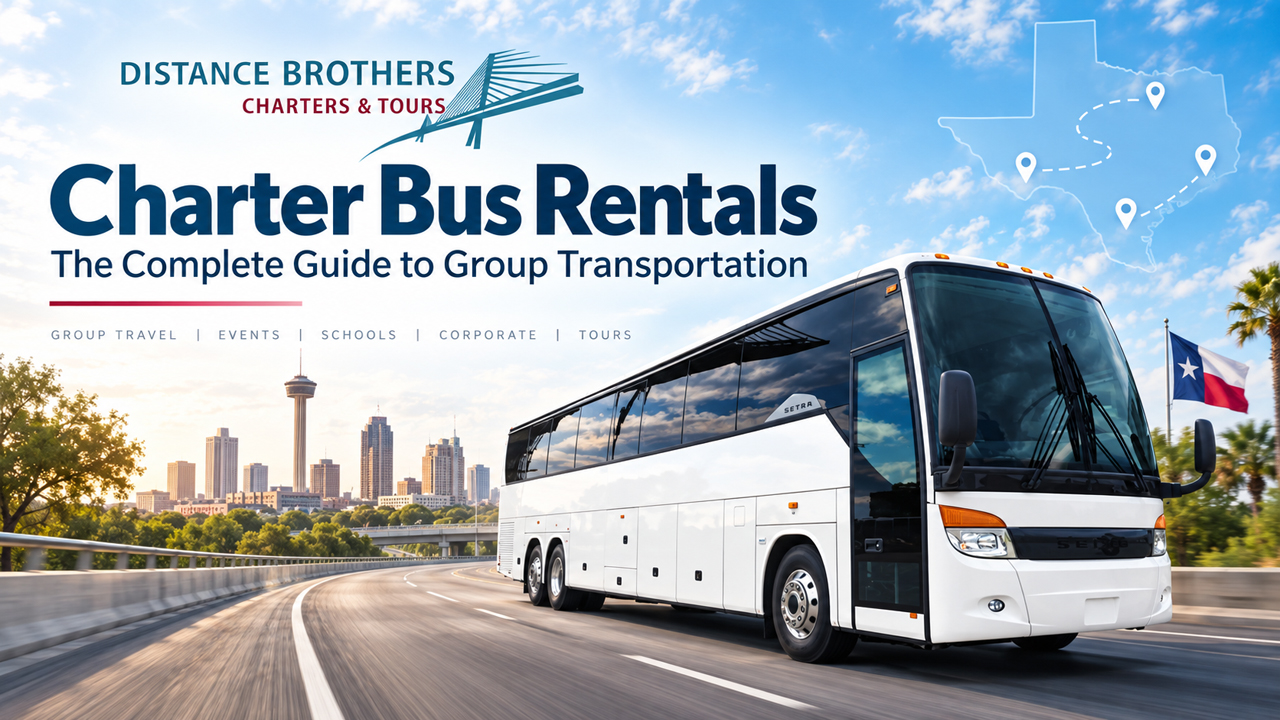
A motorcoach is a bus built for highway travel, with the passenger deck raised over a baggage compartment. Forward-facing seats fill the cabin, large windows line the sides, and bays underneath hold the luggage for the whole group.
This post sorts out what a motorcoach is and how the terms "coach bus" and "charter bus" fit around it. It also shows how a motorcoach differs from the other buses a group might book, from city buses to school buses and minibuses. The examples come from the Distance Brothers Charters & Tours fleet in Corpus Christi, so you can match the right vehicle to your trip. Each section stands on its own, so you can jump straight to the question you came with.
What Is a Motorcoach? How to Recognize One
Federal safety regulators define a motorcoach as "a bus designed with an elevated passenger deck located over a baggage compartment." That one sentence explains most of what you notice when a coach pulls up. The floor sits high, the luggage bays open from the side below the windows, and passengers climb a few steps to board.
Several other traits mark a motorcoach. A single door sits at the front. Rows of individual seats face forward along a center aisle, and every passenger has a seat, because a motorcoach has no standing room. Large side windows give riders a view of the road. The whole body is tuned for long highway runs, with a smooth ride at speed and few stops along the way.
Size is the next clue. The full-size class carries the largest groups, and the 56-passenger charter bus in the Distance Brothers fleet sits in it, with Wi-Fi, power outlets, an onboard restroom and generous luggage storage. Our full-size coaches include popular brands such as Van Hool, Setra, MCI, TEMSA and Prevost.
You will see the name written as motor coach bus, motorcoach or motor coach. All three describe the same vehicle, and the spelling a company chooses is a matter of habit.
In the RV world, "motorcoach" also names a Class A motorhome. That is a private living vehicle built for campgrounds and road trips, and it is a separate thing from the passenger coach this post covers.
Motorcoach vs. Coach Bus vs. Charter Bus: What Each Term Means
The charter bus vs coach bus question has a short answer. One word describes the vehicle, and the other describes how the vehicle is booked.
"Motorcoach" and "coach bus" name the same vehicle. If you are asking what a coach bus is, the answer is a motorcoach by another name: a bus with an elevated passenger deck over a baggage compartment, designed for longer highway trips.
"Charter" names the booking. One group hires the whole vehicle and driver for its own route and schedule. The group sets the pickup point, the stops and the return time, and nobody else boards. The model is common across the industry, with about 78 percent of motorcoach companies in the U.S. and Canada providing charter service in 2024.
Most full-size charter buses are motorcoaches, and a charter can also run on a smaller bus or van. The Distance Brothers range shows the spread. A group can charter the 56-passenger bus, the 34-passenger charter bus with luggage space and reclining seats for mid-size groups, or the 14-passenger van for airport transfers and family trips when the group is small. Each booking is a charter, and the vehicle changes with the headcount.
The terms blur together because of where the words come from. "Coach" traces back to the stagecoach, the horse-drawn carriage that carried paying passengers over long distances. "Bus" is short for "omnibus," a Latin word meaning "for all." A coach bus carries both ideas, with the long-haul comfort of the first and the shared seating of the second.
How a Motorcoach Differs From City Buses, School Buses and Minibuses
Three other vehicles get mistaken for a motorcoach, and each has a different job.
A city bus, also called a transit bus, has a low floor, several doors and room for standing passengers. It runs short, stop-and-go routes where riders hop on and off all day. A school bus is built for short trips with minimal amenities, which suits the daily route from neighborhood to campus. A minibus carries fewer people, often on a smaller chassis, and offers less luggage space. Federal regulators describe a minibus as a vehicle designed to carry 16 or more passengers, including the driver, typically built on a small truck chassis.
| Vehicle | Built for | Seating and luggage | Typical trip |
|---|---|---|---|
| Motorcoach | Highway travel | Forward-facing rows, seats for every passenger, luggage bays under the floor | Long-distance group trips, tours, tournaments, conferences |
| City bus | Public transit | Low floor, several doors, standing room, little luggage space | Short stop-and-go routes inside a city |
| School bus | Student transportation | Bench-style seating, minimal amenities | Short daily routes and local field trips |
| Minibus | Smaller groups | Fewer seats, smaller chassis, less luggage space | Shuttles, local outings and regional trips |
Groups that want a school-style vehicle for a longer outing can look at the full-size school bus built for long journeys in the Distance Brothers fleet, a 44-passenger option with overhead storage and luggage space.
What You'll Find Onboard a Motorcoach
A long ride feels shorter when the cabin does its job, and a motorcoach is set up for exactly that.
Seats recline and offer more legroom than a transit seat. The cabin is climate controlled, so the temperature holds steady through hours on the highway. Overhead racks hold small bags and jackets, while the bays below take suitcases, instruments and gear. Many full-size coaches carry an onboard restroom, which cuts down on stops. Wi-Fi and power outlets keep phones and laptops running, and TV monitors and a PA system let the driver or trip leader speak to the whole group.
The Distance Brothers 56-passenger bus lists a climate-controlled cabin, cushioned reclining seats, a TV monitor and DVD player, an onboard restroom, luggage storage, AM/FM radio, a PA system, and Wi-Fi with power outlets. Accessible coaches add a wheelchair lift. Under federal rules, a charter or tour company must provide an accessible bus with a lift and wheelchair securement on 48 hours' advance notice, and Distance Brothers offers wheelchair-accessible coach options for groups that need them.
Exact features vary by vehicle. A group that needs a restroom, a lift or extra legroom can name those amenities when it requests a quote, and the team matches the trip to a coach that carries them.
Motorcoach Safety: Seat Belts, Licensed Drivers and Driving Limits
Motorcoaches operate under federal rules that cover the equipment, the driver and the trip itself.
On equipment, NHTSA requires lap and shoulder belts at every passenger and driver seat on new motorcoaches built from November 2016 on. The agency estimates that belts could cut fatalities by up to 44 percent and moderate to severe injuries by up to 45 percent.
On the driver, any vehicle designed to carry 16 or more passengers, including the driver, calls for a commercial driver's license. The passenger endorsement requires both knowledge and skills tests, and first-time applicants complete Entry-Level Driver Training with a registered provider. A licensed, professional driver comes with every Distance Brothers rental at no additional cost, and our drivers complete medical examinations, driving-history screening and required drug and alcohol testing.
On the road, hours-of-service rules allow a passenger-carrying driver to drive up to 10 hours after 8 consecutive hours off duty, and no driving after 15 hours on duty. Weekly caps run to 60 hours on duty in 7 days, or 70 hours in 8 days for carriers that operate every day. Longer itineraries are planned around those limits.
Before the coach moves, passengers get a safety briefing after boarding. It covers the emergency exits, seat belt use, the fire extinguisher, the restroom emergency button and following the driver's directions.
When a Motorcoach Is the Right Choice for Your Group
Four questions settle most vehicle choices: how many people are traveling, how far the trip runs, how much luggage or gear comes along, and how much comfort the ride needs.
A full-size motorcoach fits large headcounts, long highway distances and heavy luggage. That is why it serves school groups heading out on field trips, sports teams traveling to games and tournaments, wedding guests moving between the ceremony and reception, corporate groups traveling to retreats and off-site meetings and conference attendees moving between hotels and venues. A team with equipment fills the bays under the floor, and a wedding party shares one ride between venues.
Smaller groups ride well in smaller vehicles. A group of 12 headed to the airport fits the 14-passenger van, and a class of 30 fits the 34-passenger bus with room for bags.
A full coach also carries an efficiency advantage. Motorcoaches average 37 grams of CO2 per passenger mile, the lowest CO2 per passenger mile of any mode analyzed in one industry study.
Book a Motorcoach in South Texas
Distance Brothers is based in Corpus Christi and operates a fleet of approximately 14 motorcoaches from a full-service facility there. The full-size coaches include brands such as Van Hool, Setra, MCI, TEMSA and Prevost, and a professional driver is part of every rental.
We serve groups across Corpus Christi, San Antonio, the Rio Grande Valley, Laredo and Victoria, with trips to destinations throughout Texas. Get a Quote with your headcount, dates and route, and the team will match your trip to the right vehicle.